
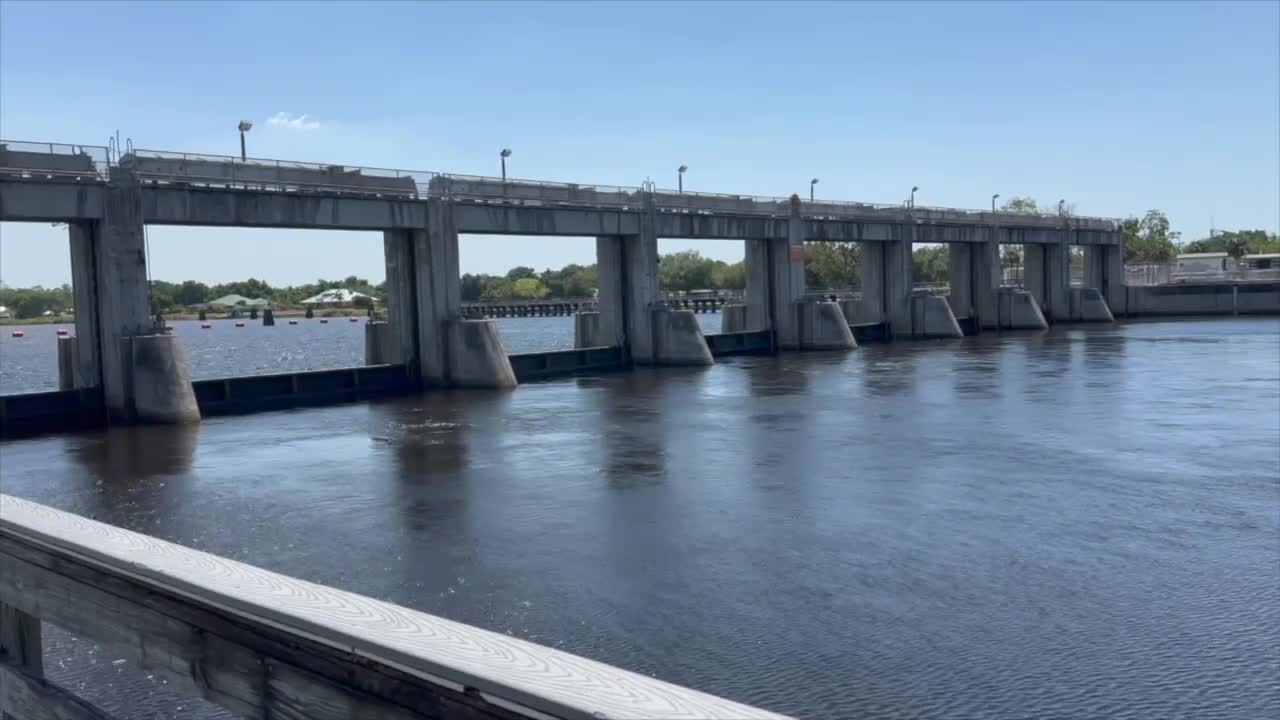


W.P. FRANKLIN LOCK AND DAMN, Fla. — As South Florida's dry season intensifies, water managers face a critical dilemma: protecting the Caloosahatchee River's fragile estuary while conserving water in Lake Okeechobee for potential future shortages.
The seasonal debate typically centers on whether too much water is being released from Lake Okeechobee—or not enough. This year, the concern is clearly the latter.
Col. Brandon Bowman, District Commander of the Jacksonville District of the U.S. Army Corps of Engineers, says a lack of water conservation could push Lake Okeechobee to extremely low levels.
"Worst-case scenario, without any water conservation measures, the lake could get down to about 9.5 feet," Bowman said.
Rising salinity threatens estuary species
Because less freshwater is moving downriver, saltwater is pushing farther inland, creating harmful salinity levels in the Caloosahatchee Estuary.
"When we have this salinity imbalance, you're talking about really big impacts to those estuarine species—tape grass and oysters," Matt DePaolis said.
DePaolis serves as Environmental Policy Director for the Sanibel-Captiva Conservation Foundation.
During the dry season, the river needs a 30-day average of 457 to 750 cubic feet per second flowing through the Franklin Lock. Over the past two weeks, flows have fallen short nine of the last 14 days.
DePaolis says the impact of missing those targets can be long-lasting and expensive to reverse.
"When we have events like this that cause damage to the estuary, it wipes out years of effort and hundreds, thousands, millions of dollars spent protecting and rebuilding these ecosystems," DePaolis said.
Water managers face competing demands
With the estuary approaching a Minimum Flow Level (MFL) violation, the South Florida Water Management District says it is being pulled in multiple directions.
Dr. Matahel Ansar, section chief with the district, says protecting the estuary must be weighed against fears of future water shortages.
"As much as we're hearing about MFL violations on the Caloosahatchee, we're also hearing from others that we need to conserve water on the lake because there's a likelihood of being under that water-shortage management zone," Ansar said.
The Army Corps is facing similar uncertainty.
"Are we going to have an above-average dry season, below average, average? How much water demand is going to be coming out of the lake?" Bowman said.
Environmental advocates urge action now
DePaolis argues that the estuary's needs must be protected while enough water is still available to do so.
"What we really should be doing is protecting the stakeholders right now while we have the resources. Then, when we're in a situation where we need to have difficult conversations—about austerity or cutbacks—we'll face them when they're necessary," DePaolis said.
This story was reported on-air by a journalist and has been converted to this platform with the assistance of AI. Our editorial team verifies all reporting on all platforms for fairness and accuracy.
