



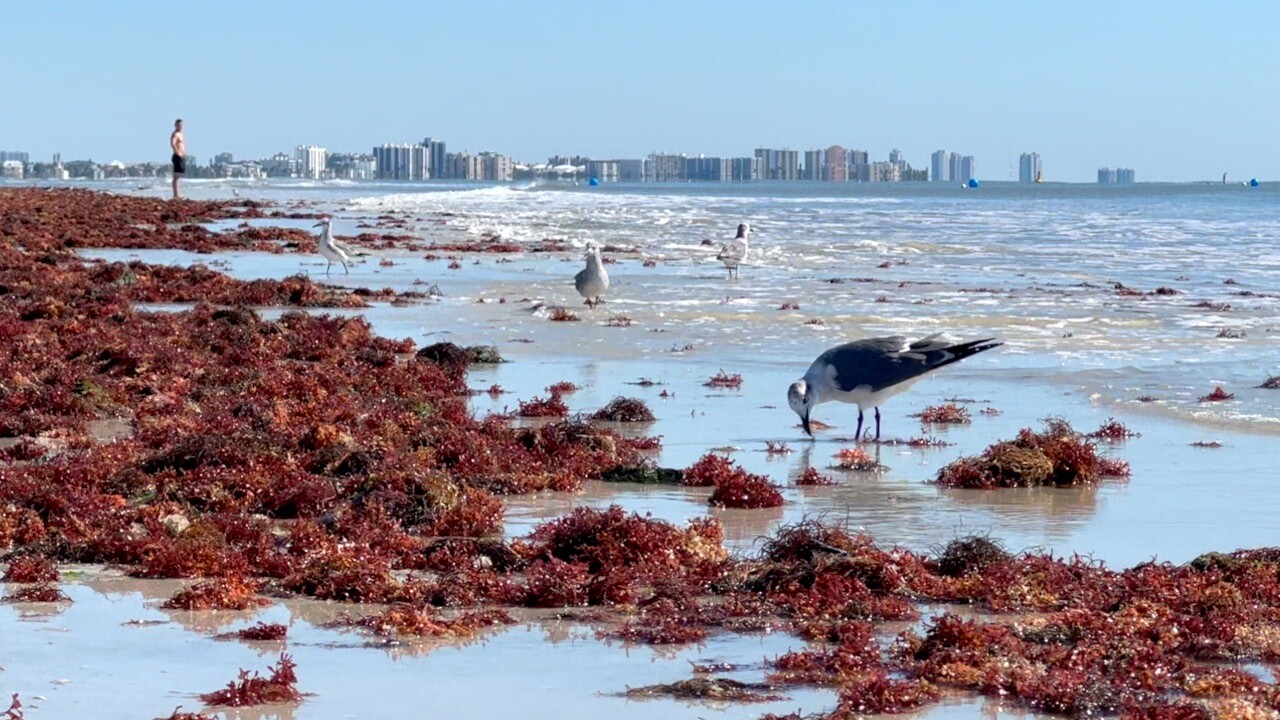
FORT MYERS BEACH, Fla — If you’ve been to Fort Myers Beach lately, then you’ve probably noticed — and maybe smelled — the piles of red algae washed up along the coastline.
Fort Myers Beach community correspondent Austin Schargorodski is out there every day, so he see’s it himself and hears the questions about it. So, he met up with a local conservationist to explain what it is and why it’s there.
Click below to hear from Ranger Rob Howell about the red drift algae and why its beneficial:
As the waves roll in, they’re bringing more than just shells to sea shore. They’re washing in red drift algae, and it has people talking.
"Its just a shock that the Fort Myers Beach area has let it get like this. I thought it would be cleaner like it used to be," said Angel Roberton
"My thoughts on the red algae is I thought it was red tide but I don't have any difficulty breathing so I was really surprised," said Gaby Zoroya.

That confusion is exactly why Schargorodski walked the beach with local conservationist Rob Howell from Keep It Wild, who says what you're seeing there is natural and necessary.
"These things consist of different types of sargassums, different types of spaghetti algae - feels like a wet spaghetti. All these are really beneficial for our beach. Not only is it feeding our migratory birds that are coming through here right now from the northern hemisphere. It also as it washes up, it gets buried with sand. All this is buried algae and it holds the beach together," said Howell, pointing at the sandy shoreline.

Howell says the algae grows offshore and floats year-round, and it's being carried in by the winds and tides. He says it's made up of large, natural algae and it is not red tide related. And while the smell can turn heads, Howell says it doesn't last.
"Occasionally you will get a smell from these types of algae because it is breaking down and biodegrading. That smell will occur as it piles up. But the next day or so sand and waves will cover it and you won't smell it anymore," said Howell.
Howell also says raking it away does more harm than good which is why it's not allowed. So while it may not be the prettiest part of the shore, Howell says it's a natural part of the beach doing it's job.
